Understand the change. Know the impact. Act safely.
empirik AI agent captures engineer intent where a change originates, maps it against the live
application environment, and gives an AI agent the evidence it needs to act safely.
graph nodes, largest
single deployment
integrations across
cloud, on-prem & SaaS
to business value
after integrations
Engineer intent
Pull requests, tickets, pipelines, console actions and agent calls.
Live application graph
Code, CI/CD, cloud, Kubernetes, VMs, IAM, network, on-prem, runtime...
Compute the impact
Resolve the intended action, project the mutation and follow every affected path.
Act safely
Plan, approve, execute and verify through durable workflows.
AI reasons. The graph supplies truth. The workflow controls action.
Inventory shows what exists. Telemetry shows what happened. empirik computes what a change will do.
empirik in action
Engineers routinely answer these questions. Just that, it
takes them multiple hours. With empirik this task automates
and gets done in a minute
Here's the blast-radius analysis and safe resize plan for i-028fa3732a11becdd.
1. What's running on this instance
This is an EKS worker node in the acme cluster (part of Auto Scaling Group eks-acme-ondemand-20260309101811868200000001-...), not a standalone box — so a resize means a node replacement, and Kubernetes will need to reschedule everything on it elsewhere in the ASG first.
Directly attached / depended-on resources:
| Category | Resource |
|---|---|
| AMI | ami-070ee402905300035 |
| Security Group | acme-node-20251030044929208900000009 |
| EBS Volumes | vol-04b92041a40c7e11b , vol-0682b35932fc70831 |
| IAM Instance Profile | eks-dece690d-5d3c-8c32-2661-e29cf3a4ef6e |
| Subnet / VPC | subnet-0cf1ed1b923a732f8 → vpc-085a354fdd1cf873c |
| Route Table / NACL | rtb-04223c90e2602b2b4 , acl-0e4f8a5778df70c28 |
| Internet Gateway / DHCP Opts | igw-0e9886691212b9fe5 , dopt-01ba4079381cb0d63 |
2. Business service impact (blast radius)
| Business Service | Path Count | Read as |
|---|---|---|
| acme api | 1,136 | Heavily exposed — largest blast radius by far |
| acme Runtime | 711 | Significant exposure |
| Shopping Product Catalog | 2 | Minor exposure |
| Acme Shopping Site | 1 | Minor exposure |
| test | 1 | Non-prod, ignorable |
| test-aug-18 | 1 | Non-prod, ignorable |
Takeaway: unlike some of the other acme nodes you've assessed (e.g. i-0dbaa8c338b662745, which is Vault/cart-heavy), this instance's dominant exposure is acme api and acme Runtime — this looks like an API/runtime-tier node rather than a stateful (Vault/Redis) node. That's good news: it likely has no quorum-sensitive StatefulSets, which lowers rollback complexity relative to your Vault-node resizes. Still confirm this with a kubectl describe node before proceeding, since 1,136 paths into acme api is not trivial.
Capture intent at the source.
The empirik AI agent reads the language, diff and workflow context at the source. It turns engineer intent into a precise action, target, reason and requested state, grounded to exact infrastructure objects.
| 1 | in >"upscale the payments node pool before weekend traffic" |
| 2 | |
| 3 | resolved > |
| 4 | ACTIONscale_node_group |
| 5 | OBJECTprod-payments-ngEKS |
| 6 | CURRENT6 nodes · m6i.2xlargeCERTAIN |
| 7 | TARGETunspecifiedAMBIGUOUS |
| 8 | WINDOW'before weekend traffic'AMBIGUOUS |
| 9 | |
| 10 | reaches > |
| 11 | subnet-2a has 14 free IPsCONSTRAINT |
| 12 | 3 PodDisruptionBudgets in pathCONFIRMED |
| 13 | account vCPU quota 78% usedCONFIRMED |
| 14 | ASK, DO NOT GUESS. The node group is certain, the target size is not. empirik returns what a scale-up reaches and puts the number back to a human. |
| 15 | |
| 16 | |
| 17 |
Not a snapshot. A living memory of your
infrastructure.
Snapshots are stale on arrival, blind to dynamic workloads like nightly jobs, and incomplete across on-prem, cloud, and SaaS. empirik compiles a graph at design time and continuously refreshes it from every change at the source. With the full blast radius always visible, teams have the clarity to act.
Partial views of now

Asset snapshots
What exists at one point in time

Service maps
What communicated at runtime
One system, continuously remembered.
One connected estate
Cloud, on-prem, Kubernetes, VMs and SaaS.
Live state
Configuration, identity, network, runtime and ownership.
Complete history
Every change stored against the resource it affected.
AI agents need both a map and memory.
“If I update this Okta policy, which services lose database access?”
“We patched the host OS yesterday, did all dependent services and scheduled jobs recover?”
AI reasoning, governed execution.
The model decides what should happen. Durable workflows enforce what
may happen and verify what actually happened.
Build the action
Create the remediation, rollback or change with impact and owner context attached.
Apply your controls
Validate policy, authority, maintenance windows and required human approvals.
Close the loop
Run through the approved path, compare intent to reality and stop if state diverges.
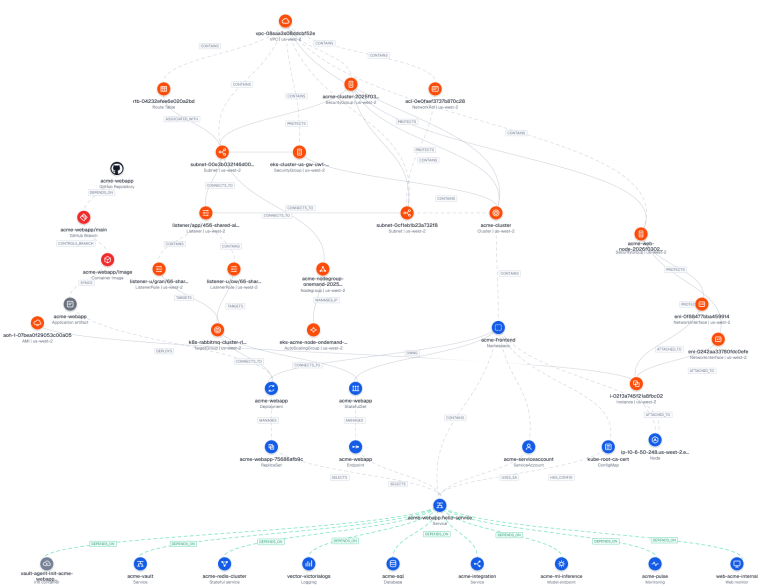
One graph across the
entire estate.
Every agent works from the same model across the systems
that define, deliver, run and govern an application.
GitHub, GitLab, Azure DevOps, tickets, diffs, authors and approvals.
CI/CD pipelines, builds, artifacts, images and code-to-runtime lineage.
AWS, Azure, GCP, OCI and provider-native services and relationships.
VMware, Linux hosts, physical servers, networks and load balancers.
Kubernetes, containers, VMs, processes, services and listeners.
IAM, secrets, routes, firewalls, policies, grants and configuration.
SaaS dependencies, integrations, external APIs and webhooks.
Telemetry, runtime behavior, dependencies and traffic.

Run into something we haven't named?
empirik is provider-agnostic. If a system declares infrastructure or records change, it can become part of the compiled graph.